6. Cross-references
The current TEI Guidelines provide several mechanisms by means of which one item of lexical information can refer to another, e.g.:
- <gloss> for the provision of simple (non refined) translation equivalents of the head word
<usg type="synonym"/>for synonym references<cit type="translation"><quote><!--...--></quote></cit>for translation equivalents in bilingual or translation dictionaries- <oRef> and <pRef> for the resolution of “~" headword placeholders in quotations and other dictionary text
- <xr> and <ref> as a general cross-referencing mechanism
<ptr/>as a pointer to another location<link/>element<mentioned/>in the etymology section<term/>for mentions of technical terms
In keeping with the approach of the TEI Lex-0, and considering that links/relations between lexical data elements are an essential part of the core lexical data model rather than mere convenience pointers for dictionary users, we need a more unified and more constrained mechanism for lexical references, whether they point to an existing lexical entity in some dictionary or lexicon, or in a more general way to lexical objects without a target reference.
The proposed mechanism has the following properties
- It applies only to references with a clear linguistic meaning.
- The number of arbitrary (or context-dependent) choices for the encoder is minimal; the semantics of the reference should not depend on context
- The relation between representing dictionary content and the underlying/implied lexical data model should be as transparent as possible
- No drastic changes to the TEI Guidelines are needed.
In the following section, we first present the recommended encoding, and then elicit how existing alternatives can be replaced accordingly.
6.1. xr vs. ref
In TEI Lex-0, we use <ref> as the general element for a lexical reference and <xr> as the enclosing element that groups all information related to this reference, including explicit labels such as "Syn.", "Cf.", "See also" etc. The reference may be internal to a dictionary or pointing to an external source, even when the actual target lexical object is not explicitly known. In the latter case, <ref> can be used without an explicit pointing attribute. Furthermore, the intended target of the reference can be a full entry, but, sometimes, also a specific sense.
For all such uses, the following attributes may be used on <xr> and <ref>:
- type is a mandatory attribute on <xr> for a lexical reference. Its default value is "related". This attribute can be used to indicate the lexical relation between the headword of the entry and the object referred to (see next section)
ref/@typeis required; it indicates the target object category (entry, sense); the type attribute on <ref> is also needed to distinguish lexicographic from bibliographic references..- xml:lang on <xr> is required when <ref> contains an explicit lexical form in a language which is different from the source language
ref/@targetto point to the URI of a lexical object. The value of this attribute is a machine-readable link to your cross-reference.ref/@notationindicates, like we currently do on <orth> or <pron>, the notation used for the explicit lexical form, where applicable
Explicit dictionary labels which indicate the type of relationship between the current lexical item and the cross-reference should be encoded as <lbl> inside of <xr>.
6.1.1. Values of ref/@target
- If the reference has no explicit target, no target is used.
- As per TEI pointing mechanisms, the value of target must be an URI reference.
- For internal references (references to the same dictionary), TEI Lex-0 enforces the use of explicit pointers to the xml:id of an element being pointed to, preceded by
#. See Section "Pointing Locally" in the TEI Guidelines. - TEI pointers should not be used in TEI Lex-0.
6.2. Cross-reference typology
6.2.2. Synonymy
Relation between two lexical units X and Y which are syntactically identical and have the property that any declarative sentence S containing X has equivalent truth conditions to another sentence S’ which is identical to S, except that X is replaced by Y. (Adapted from Cruse 1986.)
Synonymy is the linguistic parallel of the identity relation between classes. Synonyms differ in peripheral traits, related for example to stylistic, dialectal or diachronic variations.
Examples: [de] {Hund, Köter}, [en] {flashlight, torch}, [en] {glad, joyful, happy}, [en] {violin, fiddle} [en] He plays the violin very well/He plays the fiddle very well.
In TEI Lex-0, synonyms are encoded inside <xr type="synonymy"></xr>
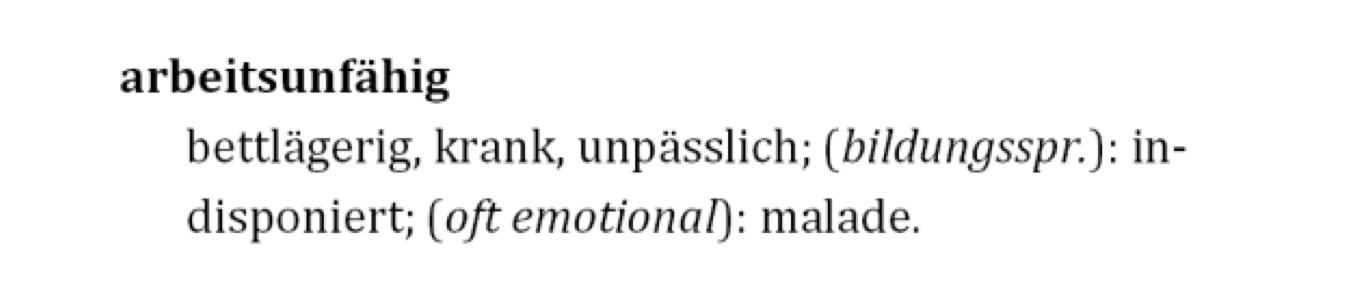
<entry xml:id="arbeitsunfähig" xml:lang="de" type="mainEntry">
 <form type="lemma">
  <orth>arbeitsunfähig</orth>
 </form>
 <sense xml:id="arbeitsunfähig.1">
  <xr type="synonymy">
   <ref type="entry">bettlägerig</ref>
  </xr>
  <pc>,</pc>
  <xr type="synonymy">
   <ref type="entry">krank</ref>
  </xr>
  <pc>,</pc>
  <xr type="synonymy">
   <ref type="entry">unpässlich</ref>
  </xr>
  <pc>;</pc>
 </sense>
 <sense xml:id="arbeitsunfähig.2">
  <pc>(</pc>
  <usg type="domain">bildungsspr.</usg>
  <pc>):</pc>
  <xr type="synonymy">
   <ref type="entry">indisponiert</ref>
  </xr>
 </sense>
 <sense xml:id="arbeitsunfähig.3">
  <xr type="synonymy">
   <pc>(</pc>
   <lbl>oft</lbl>
   <usg type="attitude">emotional</usg>
   <pc>):</pc>
   <ref type="entry">malade</ref>
  </xr>
  <pc>.</pc>
 </sense>
</entry>Duden (2007)
6.2.3. Hypernymy
Relation between lexical heads X and Y characterised by the property that the sentence This is a(n) Y entails, but is not entailed by the sentence This is a(n) X. (Adapted from Cruse 1986.)
Hypernymy is the converse of hyponymy.
Example: dog/animal (animal is a hypernym of dog)
In TEI Lex-0, hypernyms are encoded inside <xr type="hypernymy"></xr>.
<entry xml:id="XY.dog" xml:lang="en" type="mainEntry">
 <form type="lemma">
  <orth>dog</orth>
 </form>
 <gramGrp>
  <gram type="pos">n</gram>
 </gramGrp>
 <xr type="hypernymy">
  <ref type="entry">mammal</ref>
 </xr>
</entry>
6.2.4. Hyponymy
Relation between lexical units X and Y characterised by the property that the sentence This is a(n) X entails, but is not entailed by the sentence This is a(n) Y. (Adapted from Cruse 1986.)
Hyponymy and its converse hypernymy are the linguistic parallels of the relation of inclusion between two classes.
Examples: [en] animal/dog, red/scarlet, to kill/to murder
In TEI Lex-0, hyponyms are encoded inside <xr type="hyponymy"></xr>.
6.2.5. Meronymy
An inclusion relation between lexical heads X and Y which reflect a potential part-whole relation between their referents in discourse. (Adapted from Cruse 2011, p. 140)
Example: finger:hand (finger is said to be a meronym of hand, and hand is said to be the holonym of finger).
In TEI Lex-0, meornyms are encoded inside <xr type="meronymy"></xr>.
6.2.6. Antonymy
Relation between lexical units of opposite meaning.
In TEI Lex-0, antonyms are encoded inside <xr type="antonymy"></xr>.
<sense xml:id="DLPC.antepassado_a_1">
 <def>Que pertence ou viveu numa época anterior.</def>
 <xr type="synonymy">
  <ref type="sense">antecessor</ref>
 </xr>
 <xr type="synonymy">
  <ref type="sense">sucessor</ref>
 </xr>
 <xr type="antonymy">
  <ref type="sense">descendente</ref>
 </xr>
 <xr type="antonymy">
  <ref type="sense">sucessor</ref>
 </xr>
</sense>
6.3. Cross-references in definitions
In TEI, it is impossible to have a cross-reference inside a definition, yet some dictionaries do use this mechanism. In TEI Lex-0, <xr> is allowed within <def>:

<entry xml:id="VSK.SR.грдомајчић" xml:lang="sr">
 <form type="lemma">
  <orth>грдо́ма̑јчић</orth>
 </form>
 <pc>,</pc>
 <gramGrp>
  <gram type="pos">м</gram>
 </gramGrp>
 <usg type="geographic">
  <pc>(</pc>у Ц.г.<pc>)</pc>
 </usg>
 <sense xml:id="VSK.SR.грдомајчић.1">
  <def>као укор или поруга, и ваља да значи: којему је <xr type="related">
    <ref type="entry" target="#VSK.SR.мајка">мајка</ref>
   </xr> била <xr type="related">
    <ref type="entry" target="VSK.SR.грдан2">грдна</ref>
   </xr>
  </def>
  <pc>,</pc>
  <cit type="translationEquivalent" xml:lang="de">
   <form type="lemma">
    <orth>ein Schimpfwort</orth>
   </form>
  </cit>
  <pc>,</pc>
  <cit type="translationEquivalent" xml:lang="la">
   <form type="lemma">
    <orth>convicium in mulierem</orth>
   </form>
  </cit>
  <pc>.</pc>
 </sense>
</entry>
6.4. Further examples
6.4.1. More complex example including quotations
<entry xml:id="dog" xml:lang="en">
 <form type="lemma">
  <orth>dog</orth>
 </form>
 <sense xml:id="dog.1">
  <gramGrp>
   <gram type="gen" value="m">Male or unknown gender</gram>
  </gramGrp>
  <cit type="translationEquivalent" xml:lang="fr">
   <form>
    <orth>chien</orth>
   </form>
  </cit>
  <cit type="example" xml:lang="fr">
   <quote>Le matin j'ouvre au <ref type="oRef">chien</ref> et je lui fais manger sa soupe. Le soir je lui siffle de venir se coucher</quote>
   <bibl>RENARD, Poil de Carotte, 1894, p. 102.</bibl>
   <cit type="translation" xml:lang="en">
    <!-- included in the french cit, otherwise the relation is lost -->
    <quote>In the morning, I open the door for the dog, and I
     <!--...-->
    </quote>
   </cit>
  </cit>
 </sense>
 <sense xml:id="dog.2">
  <gramGrp>
   <gram type="gen" value="f">Female</gram>
  </gramGrp>
  <cit type="translationEquivalent" xml:lang="fr">
   <form type="lemma">
    <orth>chienne</orth>
   </form>
  </cit>
  <cit type="example" xml:lang="fr">
   <quote>6. Les fleuristes, murmura Lorilleux, toutes des Marie-couche-toi-là. Eh bien! Et moi? reprit la grande veuve, les lèvres pincées. Vous êtes galant. Vous savez, je ne suis pas une <ref type="oRef">chienne</ref>, je ne me mets pas les pattes en l'air, quand on siffle!</quote>
   <bibl>ZOLA, L'Assommoir, 1877, p. 681.</bibl>
   <cit type="translation" xml:lang="en">
    <quote>
     <!--...-->
    </quote>
   </cit>
  </cit>
 </sense>
</entry>
6.4.2. Antepassado

<entry xml:lang="pt" xml:id="DLPC.antepassado_a">
 <form type="lemma">
  <orth>antepassado</orth>
  <pron>ɐ̃tɨpɐsˈadu</pron>
 </form>
 <form type="inflected">
  <orth>antepassado</orth>
  <gramGrp>
   <gram type="gen">m.</gram>
  </gramGrp>
 </form>
 <form type="inflected">
  <orth>antepassada</orth>
  <gramGrp>
   <gram type="gen">f.</gram>
  </gramGrp>
  <pron>ɐ̃tɨpɐsˈadɐ</pron>
  <lbl>:1</lbl>
 </form>
 <gramGrp>
  <gram type="pos" norm="ADJ">adj.</gram>
 </gramGrp>
 <etym type="grammaticalization">
  <seg type="desc">De</seg>
  <cit type="etymon">
   <form>
    <orth extent="pref">ante-</orth>
   </form>
  </cit>
  <lbl>+</lbl>
  <cit type="etymon">
   <form>
    <orth>passado</orth>
   </form>
  </cit>
 </etym>
 <sense xml:id="DLPC.antepassado_a_1">
  <def>Que pertence ou viveu numa época anterior.</def>
  <xr type="synonymy">
   <ref type="sense">antecessor</ref>
  </xr>
  <xr type="synonymy">
   <ref type="sense">sucessor</ref>
  </xr>
  <xr type="antonymy">
   <ref type="sense">descendente</ref>
  </xr>
  <xr type="antonymy">
   <ref type="sense">sucessor</ref>
  </xr>
 </sense>
</entry>
6.4.3. Cross-references inside definitions
Allowed in TEI Lex-0. See this issue on GitHub.